

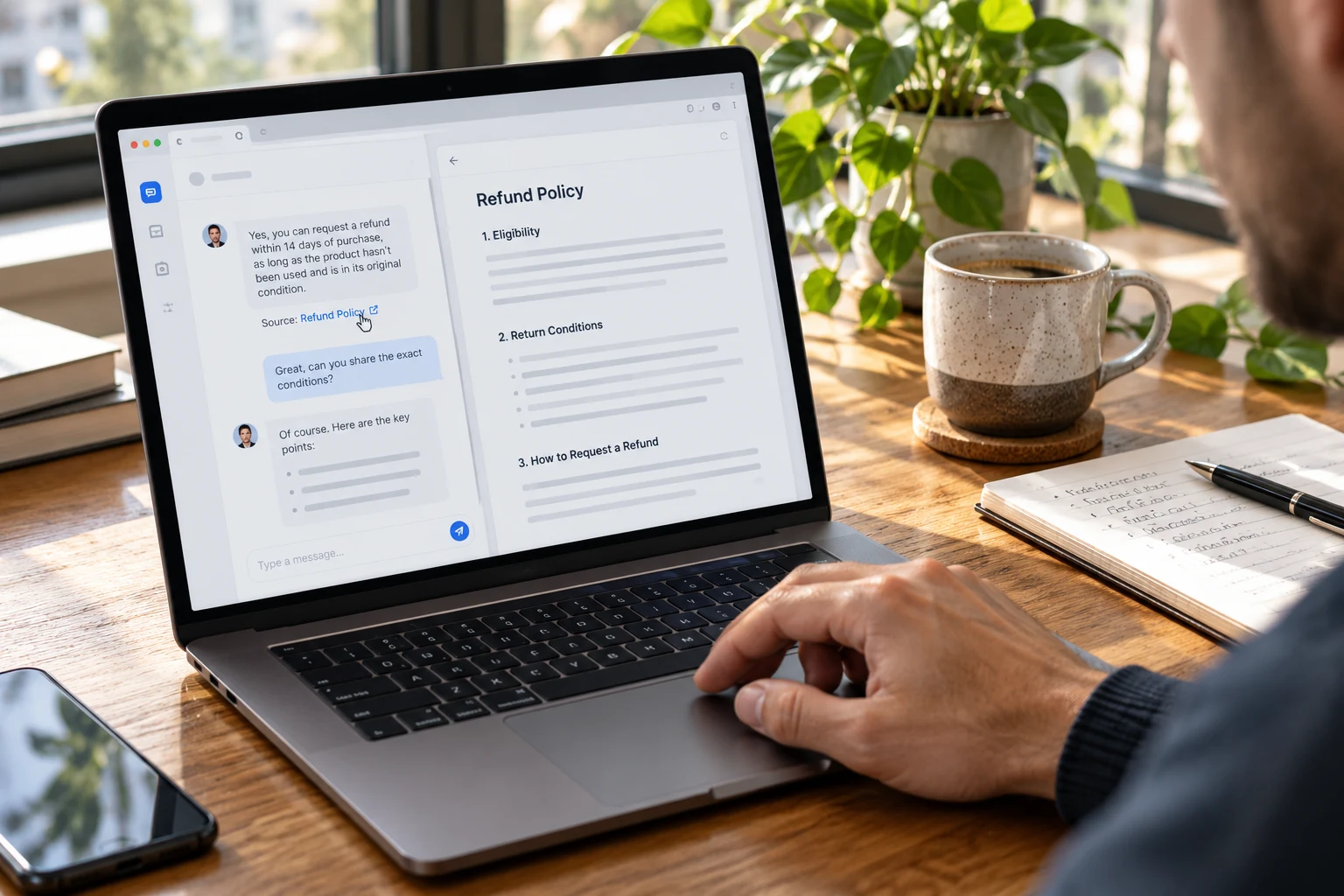
A chatbot with source citations should let you check whether a specific answer is supported by your business’s approved information. Before buying one, ask to see a real response, the source behind it and what a visitor can actually open. This guide gives you a practical way to judge that demonstration.
Ask for evidence of a claim, including its conditions
A source reference is useful when it points to the material supporting the answer. If the assistant says a subscription can be cancelled at renewal, the source should explain the renewal rule and notice period. A link to a general help centre does not establish those details.
Fictional example: ask whether a made-to-order item can be returned after 30 days. Inspect whether the answer preserves the product exception, the relevant deadline and the published process. If the policy does not settle the question, the chatbot should not turn a general returns rule into approval for that case.
Source transparency helps your team investigate an answer and helps a prospect understand its basis. It matters particularly for prices, service scope, warranties and delivery conditions. A citation does not make an outdated source current or an incorrect interpretation true.
Follow the visitor’s verification path
- Read the answer as a visitor. Identify the material claim and any condition that could change the decision.
- Open the reference from an ordinary visitor session. Check whether it is accessible without a private account.
- Find the passage supporting that specific claim. Confirm the product, market, date and exceptions.
- Compare the wording. Does the answer preserve “usually”, “subject to approval” or an exclusion instead of silently offering a guarantee?
- Try an unsupported follow-up. Check whether the assistant explains its limit and offers a realistic next step.
A document reference visible to an operator is different from a publicly accessible source. Ask the provider to demonstrate both views where documents are involved. Do not assume a reference to an uploaded file is a link a visitor can open. Decide which evidence is suitable for customers and keep private material out of the public source set.
Use a short acceptance test before choosing
| Check | Ask to see |
|---|---|
| Claim-to-source fit | An answer whose important conditions are supported by the cited passage. |
| Source boundary | How pages and documents are selected, corrected and removed from active knowledge. |
| Unknown questions | A response to an absent fact, an account-specific request and a policy exception. |
| Maintenance | A controlled source update followed by a new answer. |
| Traceability | The team’s view of the question, response and referenced source. |
Bring questions from your own sales and support conversations, without customer personal information. Record supported and correctly cited, supported but poorly cited, unsupported and declined, and unsupported but answered. Also note technically correct answers that are too vague to help the visitor.
A demonstration based entirely on the provider’s prepared examples is a starting point. A trial using your own policies and visitor wording is a more relevant basis for your purchase.
Separate a suggested link check from a published benchmark
For your own trial, check public citation URLs separately: do they open, point to the intended material and remain usable after a source update? Then assess the meaning of the answer. A reachable URL is not a correctness score.
RobiFox’s published Hungarian help-documentation test records whether an expected source reference appears in the citations, alongside answer and refusal flags. An internal file-section reference is not a public web URL; that benchmark does not test HTTP link availability or establish the factual correctness of every response. It is an internal test on one knowledge base, not an English-language or customer outcome measurement.
Check the controls behind the reference
Ask what happens when an old PDF conflicts with a current policy. Someone on the business side must decide which source governs. Look for an accountable correction process rather than expecting a model to settle a commercial disagreement.
Then ask what happens when no approved source answers the visitor. A useful response explains the boundary and offers the appropriate contact or human route. That route must match actual staffing and availability; see planning a live-agent takeover.
Use this article to judge the buying demonstration. After launch, the operator’s citation-audit guide explains how to diagnose source failures in detail.
Evaluate RobiFox with your website
Explore the source and conversation controls, then request the free website preview. It covers up to 10 website pages, uses email confirmation and sends the result by email without requiring a payment card. Use the preview as an introduction, then judge the actual responses against your sources and your acceptance questions.
Cover image: AI-generated editorial illustration, not a product screenshot.
