

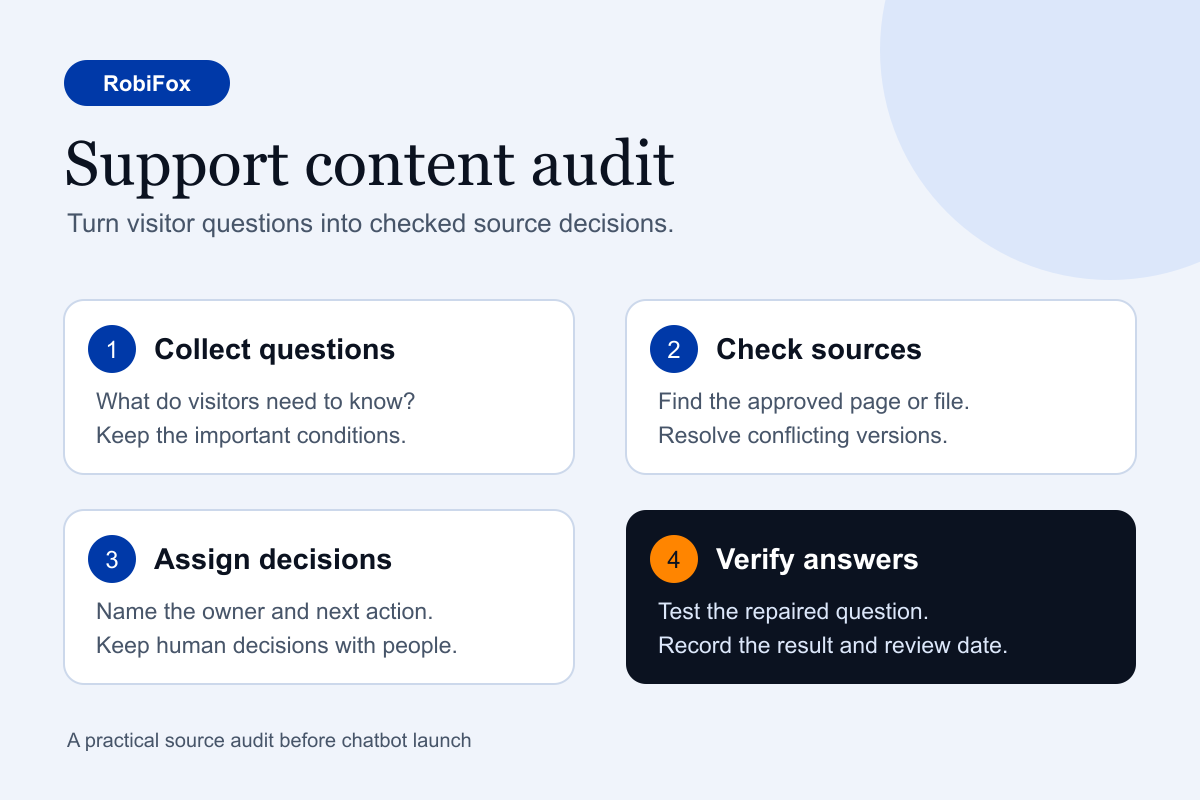
A support content audit maps the questions visitors ask to current answers, their sources and the people responsible for them. It should leave you with a usable repair list before you rely on a website assistant. This guide includes a worked example and a blank record you can copy.
Start with questions that affect a purchase or support outcome
Collect recurring questions from support, sales, contact forms and existing chat conversations. Remove personal information. Preserve the wording that revealed a difficulty, then group related questions without erasing conditions such as location, product variant or eligibility.
For a service business, start with package scope, service areas, booking requirements and how to obtain a quotation. A shop may prioritise delivery, returns and compatibility. Rank frequency alongside consequence: an occasional wrong price or contractual promise may deserve more attention than a frequent low-risk question.
Map each question to an approved source
Find the exact page or document section supporting the answer. Include pricing and service pages as well as formal help content. Record who can confirm the rule and whether the source is current. If two pages disagree, have that owner settle the difference before publishing a combined answer.
Check whether the question can be answered directly with the necessary conditions. “We offer flexible installation” does not establish which work is included, where it is available or what needs an individual quotation.
Work through one example
The following service business and its policies are fictional. Its owner has confirmed that the Standard package includes setup within Leeds and work elsewhere needs a separate quotation. A retired brochure says installation is included throughout the UK.
| Visitor question | Source and owner | Finding | Decision and verification |
|---|---|---|---|
| Is setup included outside Leeds? | Current Standard package page; service owner. | The location condition is supported, but an old brochure conflicts. | Retire the brochure from active sources, correct repeated wording and test the outside-area question. |
| Can you guarantee installation this Friday? | No approved availability source; booking team. | The answer needs current capacity and a booking decision. | Keep the commitment with a person; publish the booking contact route and test that no date is invented. |
| Where do I request a quotation? | Current contact page; sales owner. | The route exists but the service FAQ omits it. | Add a clear link to the FAQ and check it from a visitor session. |
The result is not simply “write three more FAQs”. One source needs retirement, one question should remain human-only and one answer needs a clearer route to information already available.
Copy this audit record for your business
| Field | What to enter |
|---|---|
| Question and context | Visitor wording, relevant product or service and where the question arises. |
| Expected answer | The approved fact, conditions and appropriate next step. |
| Source and version | Exact URL or document section, effective date and conflicting copies. |
| Owner | The person authorised to confirm or change the rule. |
| Finding | Clear answer, unclear wording, genuine gap, source conflict or human decision. |
| Next action | Keep, clarify, add, consolidate, retire or route to a person. |
| Verification | Who checked the change, when, and which question confirmed the result. |
Decide what should become self-service knowledge
Stable, approved facts are useful candidates: product specifications, package inclusions and published processes. Account balances, disputed orders, unpublished discounts and individual exceptions generally need access or authority that a source document does not supply.
A missing answer is a business decision. Publish it if it is useful and the owner can approve it; otherwise make the human route clear. Do not fill an empty audit cell with a plausible policy.
Turn findings into checked changes
Agree on source ownership using the governance guide, then use the content approval workflow to carry out each repair. When the issue is the wording of an individual answer, the FAQ guide is the more specific next step.
When preparing RobiFox, start with the checked sources and use the website setup guide. After launch, compare new unanswered questions with the audit: a gap may require content, while failed retrieval of an existing answer needs a different repair.
You can begin with the free website preview, which covers up to 10 website pages with email confirmation and no payment card. An audit improves the sources you provide; it is not a guarantee that every generated answer will be correct.
Cover image: editorial diagram of the audit process, not a product screenshot.
